| Requirement | Record for your exact spool |
|---|---|
| Filament | Brand, PA type and filled/unfilled formulation |
| Drying process | Required temperature, duration and permitted equipment |
| Reel | Material, dimensions and temperature limit |
| Capacity | Number of spools needing the same recipe |
| Use after drying | Storage or approved feed-through arrangement |
| Evidence | Manual, loaded-temperature evidence and support route |
Why the exact nylon matters
PA6, PA12 and fiber-filled nylon products should not be treated as one interchangeable material. Find the current drying directions for the exact filament, including time and any spool restrictions. Prusa’s guidance is useful for understanding the process, but the spool manufacturer’s instructions should govern the material you own. Save them with the product code so a future reel change does not silently inherit the wrong recipe.
Temperature headroom is a screening tool
SUNLU publishes a 35–110°C range for the E2. That makes it worth considering when a material’s documented process exceeds the ceiling of lower-temperature consumer boxes. It does not prove the whole loaded spool reaches a uniform temperature or that a shorter cycle will work. Ask for relevant loaded-chamber evidence and check the reel’s heat tolerance. Drying and annealing are different operations; a dryer advertising both does not make their recipes interchangeable.
When two zones are more useful than more heat
The S4 Pro offers two controlled zones and a published maximum of 85°C. It can be a more relevant comparison when two groups of spools need different permitted schedules within that range. Four spool positions do not create four independent recipes. Work out the actual queue before paying for capacity: two matching spools and four unrelated formulations make different demands.
Do not use humidity as proof of completion
A chamber humidity number describes conditions at its sensor, not a direct measurement of water throughout the filament. SUNLU specifically notes a protection behavior for the E2 humidity display at higher temperatures. Follow the documented drying process rather than stopping solely because a display looks low. If a print remains poor, check the material and printer setup instead of automatically increasing heat beyond the allowed range.
Plan what happens after the cycle
A storage box and an active dryer perform different jobs. Decide whether the spool will be stored sealed or fed through an approved arrangement during printing. Check the complete filament path, outlet fit and reel rotation. A box that fits a spool on a shelf may still feed poorly in your printer layout. Avoid exposing a prepared spool longer than necessary while changing equipment.
Compare ownership costs and support
Record the delivered price, usable spool dimensions, regional electrical version and warranty route. Include extra storage boxes or adapters only if your process needs them. An inexpensive dryer that cannot meet your filament’s instructions is not a bargain, but a higher-temperature model is not automatically better for materials that do not require it.
Our shortlist
Consider the E2 when the exact nylon process requires its additional temperature capability; compare the S4 Pro when controlled batch scheduling within its range matters more. Both have existing manufacturer-direct affiliate routes on SpoolSignal. We have not performed a head-to-head loaded drying test, so these are specification-based shortlists, not claims of equal temperature uniformity, reliability or guaranteed print strength. Use the linked model profiles to check limits before ordering.
Models to compare
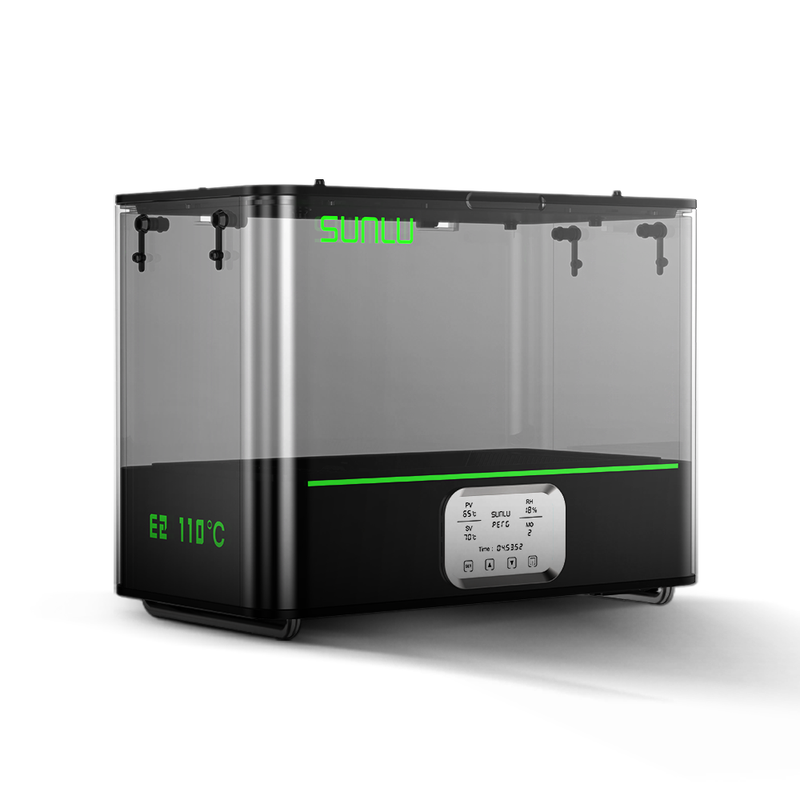
Higher-temperature chamber
SUNLU E2
A higher published ceiling for demanding material requirements.
- Spools*
- 2
- Max temp
- 110°C
- Zones
- 1
Spool temperature limits matter as much as the dryer's ceiling.
Model details →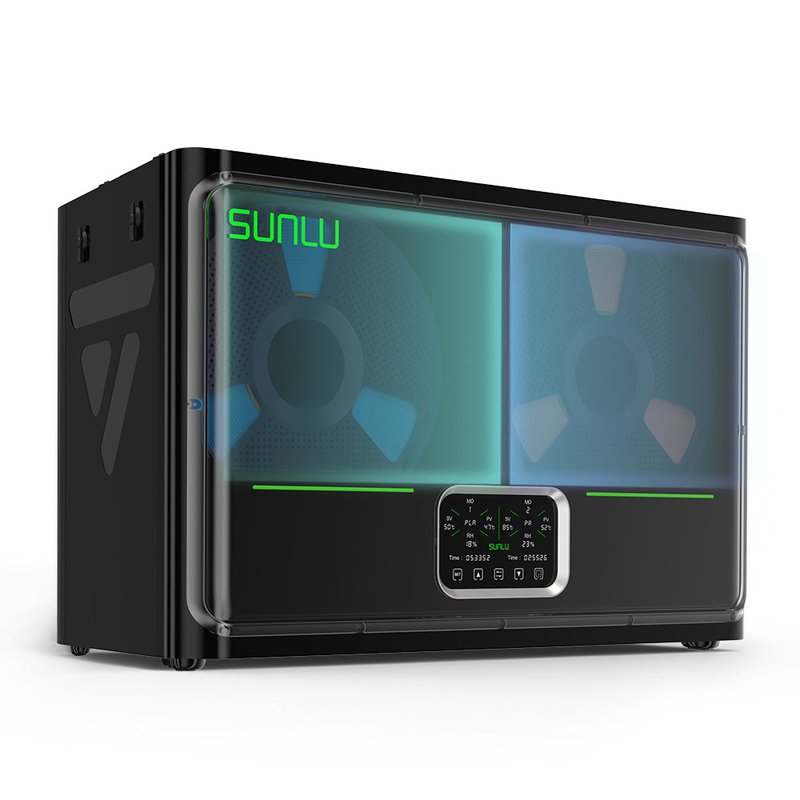
Two controlled zones
SUNLU S4 Pro
Two temperature and time settings across four spools.
- Spools*
- 4
- Max temp
- 85°C
- Zones
- 2
Two zones offer more scheduling flexibility than one shared chamber.
Model details →Sources for this comparison
- Prusa: filament drying guidance
- SUNLU: E2 specifications and operating notes
- SUNLU: S4 Pro specifications
Specifications checked 2 October 2026. Editorial buying analysis; no hands-on test is claimed.